
Lyon Healy Sax Serial Numbers
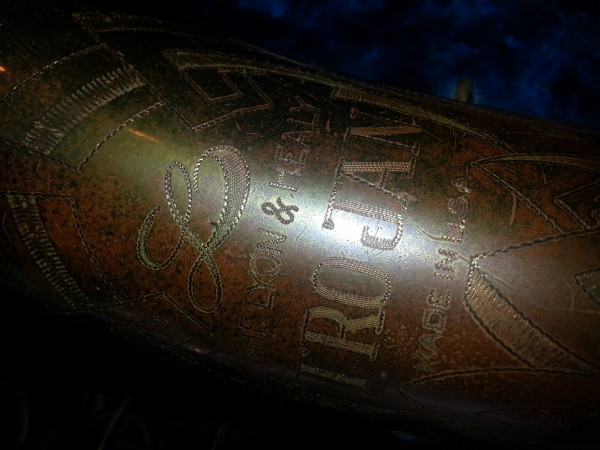
I am trying to find more information on the saxophone that i have had in my family for years and years. I know for sure it is a lyon healy stencil but i'm not sure who the original maker of it is. I was told Buescher made most of their stencils but i haven't found exactly what mine looks like on other sites yet. The neck has a small curve in it but is straight and it doesn't have the fin on it. The body has the fin on the bottom of the bell. This is a poor picture of what i own. It has a lyon healy engraving on the bell that is a very simple floralish pattern.
The serial number is 12909 which i also could not find any information on. If anyone could help me find a year on this or how much it might be worth i would be greatful. I had no idea where to put this lol. I know its old.
We found it in my great grandmothers basement and before that it had belonged to a long deceased relative of mine. Its in decent condition. Some tarnish and needs new pads. But it plays beautifully. It could use a new mouthpiece too. As i dont know how old this one is. I've cleaned it but its kind of.
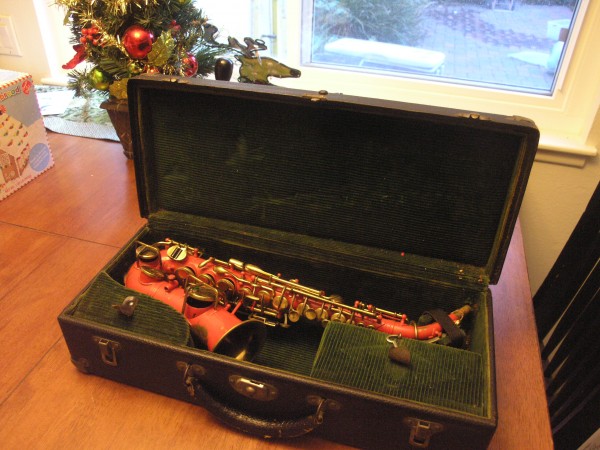
Gross in some parts. Ya that's just how mouthpieces get, especially when they are old. My old CONN mouthpiece i first started out with is a dark brown/green nowadays, but still plays well for beginners.
Lyon Healy Sax Serial Numbers In English
Lyon & Healy produced their own horns for a while, with a mix of identifiable features, this one typically has a Martin style bow fin (not Buescher.) and a Conn 'mercedes' low C guard. Can maybe make out bevelled toneholes Need pictures of the bell engraving, and other details - as milandro commented - does it by any chance say 'LaPorte' anywhere on the engraving? The link below is to a C-Melody (not alto like yours), but note the Martin'ish bow fin and bevelled toneholes, but Conn low-C cage and neck brace. And has been mentioned before by Grumps, Buescher/Martin/Conn serial number lists do not apply to stencils manufactured by those companies, so you cannot date the sax with those. Another interesting webpage link below about Lyon & Healy, with further links on that web-page - there is other ongoing L&H research taking place, it's become a bit of a cult, and of particular interest to me as I have both L&H C-Melody and C-Soprano saxes. So klhanson, a few more pics please, especially of the bell engraving and tone-hole closeups. The first one was fine, just need more details if you want proper identification, and sadly a couple of hundred dollars might well be all it's worth - if it's a LaPorte Couturier, a collector may pay more (may.).
Sad, because the build quality (and sound) of the L&H's I've owned and played far exceeded their achievable market value and that state will probably continue. The tone holes are not straight they are a little angled at the top. The serial number has a A on the top then 12909 in the middle and then a L on the bottom. I will get a few more pictures, one of the engraving especially here shortly. It doesn't say la porte on it anywhere that i can find. All it says is Lyon healy in fancy script with -inf under that. And then it says american professional chicago in regular script on it.
The engraving itself is just a floral looking thing with the words inside a 'Frame'.
. Follow Blog via Email Enter your email address to follow this blog and receive notifications of new posts by email. Join 167 other followers.
Your 1st stop for Saxophone Resources-The Oldest and #1 Rated Online Resource for Saxophone Professionals and Enthusiasts including historical information, tips and tricks, and more. Saxophone Stencil Makers Sax Gourmet.
Recent Comments on Pierre on on Victoria on Gysbrechts on. Will be writing reviews of King Super 20 and Hawkes tenor soon. just got my hands on a superb silver-plated Hawkes & Son Double Century tenor - complete with Admiralty Patent and broad arrow marks. At last - we've managed to find an Amati AAS 22 alto saxophone to review - all power to Kralice and Europe!.
read our review of the Condor alto saxophone. vote for your favourite maker. The Story I bought this alto from, who are based in the West Country. Over the years I have acquired a number of fine instruments from Tony, who is a keen on sailing, so we sometimes meet in the car park of a local reservoir when something interesting comes up. This was one of a couple I bought at the time. What a grand tribute to capitalism it is – to be buying ancient saxophones on a Sunday morning from the back of Tony’s estate car.
He has a lot of different instruments for sale, although I believe violins are perhaps his main thing. The Instrument Lyon and Healy were a US-based department store, opening for business in the 19th century.
In fact they still exist as. The company, still based in Chicago, Ill., USA was formed in 1864 and began making brass instruments in around 1890. According to it boasted making 100,000 instruments a year in its 1892 catalog, making it an interesting precursor of the major companies like Conn, Selmer, Martin and Buescher who would manufacture these kinds of numbers for saxophones alone in the late 1920s and Yamaha, who would do so again in the 1960s. Although they manufactured a few of their own horns (see the excellent article at ) – it looks as if the majority of their instruments were made (albeit to their own designs) by other companies. I have no doubt that my sax was made by Martin from the bevelled tone holes and the font of the ‘PAT APPLD FOR’ stamp above the serial number.
According to the serial number would make the year of manufacture 1920, which seems appropriate for its features. John Henry Martin had worked for Conn in Elkhart, Ill., USA and others before he set up the Martin Band Instrument Company in 1905. I have a few of their horns and find them all to be expertly made, if a bit light on the weight of brass.
In this case the horn is a ‘clapper’, with the low B on the left and the low Bb on the right from the player’s point of view. I can’t tell if this was originally lacquered or not – if it was, it’s totally faded now. On balance I think it was a polished brass finish. It appears dullish to look at, although an excellent renovation by my sax technician has made it very playable. One very interesting feature is that the G# key also controls the bottom C#, rather than having a single key for each.
I’ve never seen this feature on any other sax and it was almost certainly added by Lyon and Healy at the design stage. While arguably it simplifies things for the player, I find the additional weight makes it harder to play G#.
It also has an extra pivoted spring at the top just behind the upper octave hole on the neck, which certainly does make the octave key more reliable. In other details it is very similar to a Martin Handcraft and includes a Selmer ‘cigar cutter’ style octave key. It has the serial number repeated on the neck and the face of a clown etched on the bell above the ‘Lyon and Healy, Maker, Chicago, USA’. According to the 1926 this alto was priced at $111.75 (including case) when new. The Player It would be wrong to suppose a saxophone from the 1920s would play as easily as a modern horn. As I noted above, the G#/C# key is a bit heavy under the left hand ‘pinky’ and the pearls feel more widely spaced and harder to depress than on a modern balanced instrument. However the sound is loud and true when played with my Berg Larsen ebonite 6 (with Rico 3 1/2 reed) mouthpiece.
It’s certainly not a ‘peashooter’ – a name used to describe early saxophones with a narrow bore towards the neck end and hard to keep in tune in the upper register. I’ve included a of the horn from my saxachronic chamber.
Saxifications. Make – Lyon and Healy (Martin stencil).
Model – Artist alto. Serial Number – 20,097. Date of Manufacture – 1920.
Place of Manufacture – Elkhart, Indiana, USA. Finish – Polished Brass. Weight – 4lbs 2oz. Sound – Mature and loud, well in tune in upper register. Ease of Blowing – Somewhat strenuous.
Ease of Fingering – Offers more resistence than modern instruments More about Lyon and Healy saxophones can be found currently on the Web from and in addition to the saxpics and catalog from Vinatage Images referrenced above. Do you own a Lyon and Healy? Do you see value in the conjoined ‘pinky’ keys?

Please let me know by commenting on this post. On said: Mike Thanks so much for your comment. Your Lyon and Healy is almost certainly a Conn stencil – the ‘Patd Dec 8’ refers to a patent it took out on its rolled tone holes (although my Pan American has the inscription, but no rolling). My Lyon and Healy has a Clown motif, although it’s difficult to see from the photos.
Lyon and Healy had some interesting design inputs to their saxes, so it would be interesting to see how your C soproano looks. Let me know if you’d like us to cover it here. A simple, but unique idea - supply the description, review what the horn is like to play, weigh it and provide a video of what it sounds like. These are all the things you need to know when investing in a new instrument, or trying to learn about it when you get it home. I hope you enjoy the reviews. Let me know what you think. Send me your questions on your vintage sax and I'll do my best to answer them accurately and quickly.
Saximus Maximus. Saximus Maximus Reviews Saximus Maximus Reviews.
Lyon Healy Sax Serial Numbers List
Cloud Saxophoning.